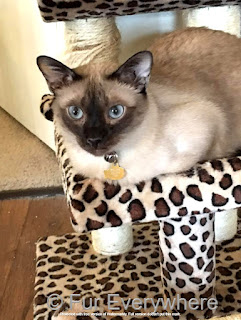
I am delighted to be sharing a guest post today from Leslie Goodwin, author of Cat Skills: Loving Care for Cats.
Leslie's 15-month-old kitty passed away from FIP in June, 2014. She had adopted her a mere eight months earlier. Since then, Leslie has been studying FIP, helping others with FIP cats on the FIP Yahoo support group, and recently raised $1,650 for FIP research through a Crowdfunding campaign. There were 16 donors, and one donor even got her employer, Alaska Airlines, to match her donation.
I will be reviewing Leslie's book,
Cat Skills, on Friday. You will also have a chance to
win a copy of the book for yourself, so please come back and enter the giveaway.
Thank you so much, Leslie, for writing this amazing post to inform others about FIP. I feel honored that I had the opportunity to meet you and to call you my friend.
Leslie Goodwin's Guest Post:
Sierra recently asked me to guest blog about a misunderstood and devastating feline disease that struck one of my young kitties, Maisie. During Maisie's illness, I was desperate to understand what was happening. I found some confusing and conflicting information. Then I sought help from a support site. They inspired me to learn more so I could repay them and share what I've learned with other victims. Leslie Goodwin
Leslie Goodwin's Angel Maisie.
Photo courtesy of Leslie Goodwin.
FIP Myths and Mysteries
FIP has only been identified since 1963 and remains shrouded in mystery and myth. Veterinarians are often puzzled when diagnosing a cat they suspect has FIP because it is relatively rare and takes two forms: Wet and dry. Dry F.I.P., with no abdominal effusion present, is one of the most misdiagnosed and mysterious of all cat diseases. Because it can be difficult and expensive to diagnose, it is often only confirmed post-mortem.
Wet FIP is more obvious; the cat develops a huge belly filled with fluid. Both types are caused by a mutation of the Feline Enteric Corona virus. Victims are almost exclusively under two or over ten years old. They rarely live more than a few months after symptoms appear. There is no effective vaccine. There is no single diagnostic test. There is no sure treatment or cure. FIP kills one in 100 to one in 300 of all cats under five years old (mostly kittens). And the incidence can be up to ten times greater among kittens from catteries or in overcrowded populations. Humans cannot transmit or contract FIP.
Here are some of the most common misconceptions:
Myth number # 1: Testing my cat for corona virus titers will diagnose FIP: Wrong. If your vet suspects your cat has FIP, don't waste your money on a corona virus antibodies titer test. Ask for a CBC and chem panel instead. About 80% of cats will test positive for antibodies to corona virus but may never become ill with FIP. FIP happens when the virus mutates. It is most likely to mutate when a cat is under extreme stress like being in a shelter, after surgery, in a new home, or when they stray. Testing for corona virus titers can support a diagnosis because a cat with no corona virus titers cannot have FIP.
Myth number #2: FIP is contagious. My other cats will catch it. Despite its name, FIP isn't contagious...exposure to the corona virus, however, can be spread, passing in feces dust when cats track it from litter boxes and then lick it off while grooming. You can test feces for presence of corona virus if you want to know if a cat is shedding virus. Some cats shed virus constantly, others for a time period after being exposed and some never shed. There is no hard and fast rule on virus shedding. But after a cat dies of FIP, it is recommended to disinfect all boxes and discard used litter and vacuum the entire house and wait to bring in a new cat for at least 8 weeks, while the virus is still viable. Again, just because your cat lived with an FIP cat does not mean your cat will get sick.
Myth number #3: FIP is genetic and all related cats will also get FIP. Not necessarily. A genetic tie is not proven yet...though some researchers believe it does run in families and some believe it is passed by the father of the kittens. However, purebred cats coming from catteries or cats who live in multiple cat households or shelters and are exposed at a young age to many others are more likely to be exposed to the virus and thus...at more risk of developing FIP if the virus mutates.
Myth #4: You can vaccinate for FIP. Yes...but the Felocell vaccine isn't universally recommended as it isn't proven to be effective in most cases. See link below for more info.
Myth #5: FIP can be diagnosed from a fecal test. No way. A fecal test for corona virus will only show that a cat is shedding virus.
Myth #6: FIP can only be diagnosed after death. Not quite true. To diagnose FIP, you have to analyze symptoms and run tests to rule out differential diagnoses. It can be expensive and complicated- so FIP is often misdiagnosed or goes un-diagnosed. The first step is to run CBC blood tests. The obvious markers of FIP: High total protein, a low A/G ratio, (high globulin), nonregenerative anemia, lymphopenia (low lymphocytes) and sometimes elevated neutrophils. These are the red flags for FIP.
Symptoms are: Fever which doesn't respond to antibiotics, anorexia, diarrhea, lethargy and weight loss and/or abdominal swelling (in the case of the wet type.) Vets often prescribe antibiotics immediately to rule out other reasons causing fever because if the cat improves, he certainly doesn't have FIP. Next, abdominal ultrasounds to monitor changes in the internal organs and cytology tests (analyzing cells) of the abdominal fluids can reveal cell changes characteristic to FIP. The abdominal fluid (wet type) is a tell-tale yellow straw color and appears fibrous. There is a simple test of the abdominal fluid called the Rivalta test which can be done in the vet's office in minutes and costs virtually nothing...but only for testing the abdominal fluids in wet FIP. A Youtube video explains how to do it. These are the preliminary tests..there are more advanced tests, too. Dr. Addie devised an ingenious flowchart for vets which explains how to test and interpret test results to diagnose FIP. Check the links in the bibliography to find out more.
Some female kittens are diagnosed with FIP during spay surgeries when vets observe damage to organs or lymph nodes. In one case I know, the vet could remove the infected lymph nodes and with supportive therapy, save the kitten's life. She is the subject of a study soon to be published. She has survived for three years so far being treated with Polyprenyl Immunostimulant and shows no sign of disease. Her recent blood work is normal. She had the dry type. She may be the only case of her kind.
It's rare for any cat to survive FIP. There are some palliative treatments and a few experimental drugs but no cure. Cats are usually given prednisone which slows the inflammatory process and improves their appetite and quality of life. Vets can extract the belly fluid and/or give the cat Lasix to make him more comfortable. The two drugs used are Polyprenyl Immunostimulant and Feline Omega Interferon. PI is also used effectively to boost the immune system to treat feline Herpes. FOI is not readily available in the US. Human grade interferon has also been used but is not considered as effective. PI treats the dry type only and must be given for the life of the cat.
Since I have been reading and communicating with dozens of victims on the support site, I personally know of only one cat with wet FIP who survived for more than seven months. He lived for 13 months on daily doses of FOI. There is a new Facebook group of FIP survivors with about 50 members, most of whom are taking PI. Drugs might be more effective if we could diagnose cats sooner...the challenge with FIP is the speed at which it kills...usually within two weeks of being diagnosed...and the time it takes to diagnose.
Researchers are getting closer to developing and testing protease inhibitors designed to stop Corona virus from mutating into the deadly forms. A researching studying FIPV at Cornell University, explained the unique challenge; they have isolated 40 different strains of FIPV. Making matters worse, he said, they now think there may be interspecies spread of Corona virus between dogs and cats.
One famed Scottish researcher, Dr. Diane Addie, advocates isolating cats with high corona virus titers to stop the spread of the virus and is working with breeders on controlling it in catteries, saying that purebred cats because they’re raised indoors are more likely than ferals or strays to have high Corona virus titers.
No FIP in the Falklands Islands! Some years ago, the vets on the Falklands Islands, suspecting that the cats who lived there were already FCoV free, instituted a policy requiring all cats imported to the islands to test negative for antibodies to Feline Corona virus. Dr. Addie and friends published a paper documenting the experiment and its success.
However, in most countries, isolating every cat with Corona virus antibodies is impractical since so many healthy cats would test positive. And not every cat with high Corona virus antibodies is actively shedding virus in their feces and thus spreading it. The only way to know if a carrier cat is shedding virus is to test their feces regularly. This is how catteries can control the spread of Corona virus..by monitoring which cats are shedding and preventing them from sharing litter boxes and by limiting populations in general. Most animal shelters don't have the space to keep all kittens separated so they can't share litter boxes but it would help stop the spread of Corona virus in the long term to try to limit virus passing in cats younger than 4 months. Dr. Addie is also exploring the idea of creating litter that would kill the virus.
Exposure to Corona virus or to an FIP cat or having high Corona virus titers does not mean your cat will get sick. The mutation to FIPV is relatively rare. I lost Maisie to dry FIP in June of 2014 and her BFF, Millie, was undoubtedly exposed to Corona virus from her. Yet I never have and most likely never will have Millie tested for Corona virus antibodies because Millie has a strong immune system and the chance that she will develop the FIPV mutation is low enough that it isn't worth worrying about. But, before I adopted a new sister for Millie, I waited 6 weeks for the virus to die and cleaned every speck of dust in my house, sterilized all the litter boxes and started with fresh litter.
I did not test my new kitty for Corona virus either...but I didn't adopt from either of the two highest risk groups: purebred cats and kittens. That's another great reason to adopt an older cat..they have survived diseases that mostly affect kittens. I keep three litter boxes for two cats and they also go outside in their Catio. I scoop at least once a day.
After losing a young cat to a deadly disease, I was changed...for the better. I've learned not to dread the future or focus on past losses. I just enjoy every minute of every day with my fur kids. None of them come with a warranty.
FIP pet parents are pawsome! Their grassroots efforts to raise money to find a cure for FIP amaze me. They have online auctions, bake sales, fundraise at cat shows and hold raffles. I made a video for my recent crowdfunding campaign which tells our story and introduces some other FIP angels (link below). Together, we raised $1,650. to support FIP research. Some FIP pet parents have even donated tissues and other samples from their cats for research. I've included links for you to support a cure for FIP. If you have an FIP question, look me up on Facebook. I will help if I can.
©2015 Leslie Goodwin, author of CAT SKILLS: Loving Care for Cats available on Amazon.com and Barnes & Noble.com Thanks to Susan Gingrich and Sue Meissner for feedback on the Felocell vaccine.
Links to learn more about FIP:
Felocell vaccination and more:
Book:
Feline Infectious Peritonitis and Corona virus, everything a cat owner needs to know by Dr. Diane D. Addie
Support Groups:
FIP Fighters on Facebook
Donate to FIP research:
Bria Fund
Dr. Diane Addie.com